The rapidly developing print world, forever changed by the advent of inkjet printing, is now experiencing another revolution: Additive Manufacturing, also known as 3D Printing. Not only is this process broadening print applications, it's becoming an integral tool of the manufacturing industry, boasting lower costs and better adaptability than traditional manufacturing systems.
With development from companies like Nazdar and Xaar, Additive Manufacturing will soon have even better volume speeds as well, and could prove to be as much of a groundbreaking development for mass production as inkjet was for print.
Additive Manufacturing Overview
In the past, conventional manufacturing has largely involved tooling, a type of Subtractive Manufacturing in which material is removed from a work piece to achieve its final shape. These cutting tools must be harder than the material being cut, requiring specified tools based on material used. Material being cut off is generally not reusable, resulting in waste. Injection molds are also often used to create pieces; changes to these molds can take time, holding up production. Both tooling and injection-molding are limited in the complexity that they can give a piece without additional assembly, notably with inner-components.
All types of additive manufacturing offer some shared advantages over conventional manufacturing. Model design changes can be made in software and sent directly to production, eliminating costly retooling and saving time. As additive manufacturing focuses on producing only the pieces' materials (instead of cutting away), waste is greatly reduced or completely eliminated. Models can also be built in very geometrically-complex solid structures that aren't possible with tooling or injection molding.
3D printing can be accomplished via several different methods; we'll look at Fused Deposition Modeling (FDM), Stereolithography (SL), Laser Sintering (LS), and High Speed Sintering (HSS). While each print process is different, model set up is similar. First, a 3D model is created in modeling software, then prepped for printing by splitting up the model into multiple flat, 2D layers. Each of these 2D layers will be printed on top of one another, stacking to form the 3D object. However, there are several different options for the process of creating these layers.
Fused Deposition Modeling (FDM)

Filament is heated and extruded into place.
Fused Deposition Modeling is what most people are familiar with as "3D printing." It involves a plastic filament being fed through a hot extruder to create each layer of the model. If necessary, support materials are printed as well, building up the model off of the print bed (these are later removed from piece).
While FDM is an easy, relatively cheap option for creating colorful prototypes, its speed and resolution do not lend themselves to finalized end-use products.
| Pros |
Cons |
- Relatively inexpensive and common
- Lower-end models can be purchased for a few hundred dollars.
- The only consumable are the filament rolls
- Filament rolls are available from a wide selection of sources.
- Polymer filament rolls can include a variety of fillers
- Ceramic, Metals, Carbon Fiber, etc.
- Filament rolls come in a variety of colors
- Removal of piece from print bed and support materials is relatively easy
|
- Pieces have poorer resolution (rougher layers, more ridges visible)
- Resolution is based on nozzle size
- Lower bonding force between layers
- Can more easily break along layer lines
- Weight of upper layers can cause shifting to occur, making model slightly skewed
- Support materials are generally not reusable, producing waste
|
StereoLithoGraphy (SL)

Photopolymer liquid resin is hardened using a laser.
StereoLithoGraphy takes a very different approach to printing than FDM. While SL also creates layers by solidifying a liquefied material, instead of ejecting material from an extruder, SL utilizes a resin bath and a laser.
A platform sitting in the resin bath is lifted to just below the liquid's surface, leaving a thin liquid layer. The resin layer, consisting of a curable photopolymer, is then exposed to focused laser light; the laser traces out the layer, hardening the resin material into a solid.
Once the layer is complete, the platform is lowered to allow a new layer of liquid resin to cover the previous, repeating the process with the next cross-section of the model. Once complete, the model is removed from the bath and placed in isopropyl alcohol to remove any excess, uncured resin. Any support structures are then removed.
SL can produce smooth, finely detailed models, but is more limited in materials than other AM methods, both in type and in availability, and is usually too slow to make full production runs.
| Pros |
Cons |
- Higher accuracy
- Resolution is based on laser spot size
- Smoother models, finer details
- Less likely to break along layer lines than FDM models
- Excess uncured resin is reusable
|
- Resin choice is more limited than FDM
- Resins are proprietary and can't be exchanged between printer makes
- Resins are only available from manufacturers
- Models are limited to one color at a time
- Printed supports not reusable, producing waste
- Supports are difficult to remove as they are made from the same material as the part
- Higher costs than FDM
- Resin tanks and build platforms need to be replaced relatively often to ensure accuracy of laser
- Generally slower than FDM
|
Laser Sintering (LS)

Layers of powdered plastic are fused using a laser.
Laser Sintering, like SL, uses a laser to draw out each 3D model layer. However, LS uses powder instead of resin. A layer of powder is levelled across the build tray, then the laser sinters the piece's cross section, fusing the powder together and to the previous layer. Once the model is created, the model is removed from the block and brushed clean of excess powder.
LS opens the door to a wide range of durable functional prototypes. However, like SL, this laser-based method suffers from slow speeds, making high-volume production runs impractical.
| Pros |
Cons |
- Surrounding powder acts as a support, so little to no support structures are needed
- Wide variety of materials can be used
- i.e. different types of plastic, metal
- Results can be stronger and more durable than with SL
- Results can be more flexible than with SL
- Food safe options are available
- Materials are generally cheaper than SL resins
- Provides the highest geometric flexibility of Additive Manufacturing processes
|
- Resin choice is more limited than FDM
- Resins are proprietary and can't be exchanged between printer makes
- Resins are only available from manufacturers
- Parts are limited to one color at a time
- Based on powdered polymer color
- Printed supports not reusable, producing waste
- Restricted resuability use of "part cake" powder (block of powder encompassing part) as high recycling leads to poor surface quality parts
|
High Speed Sintering (HSS)
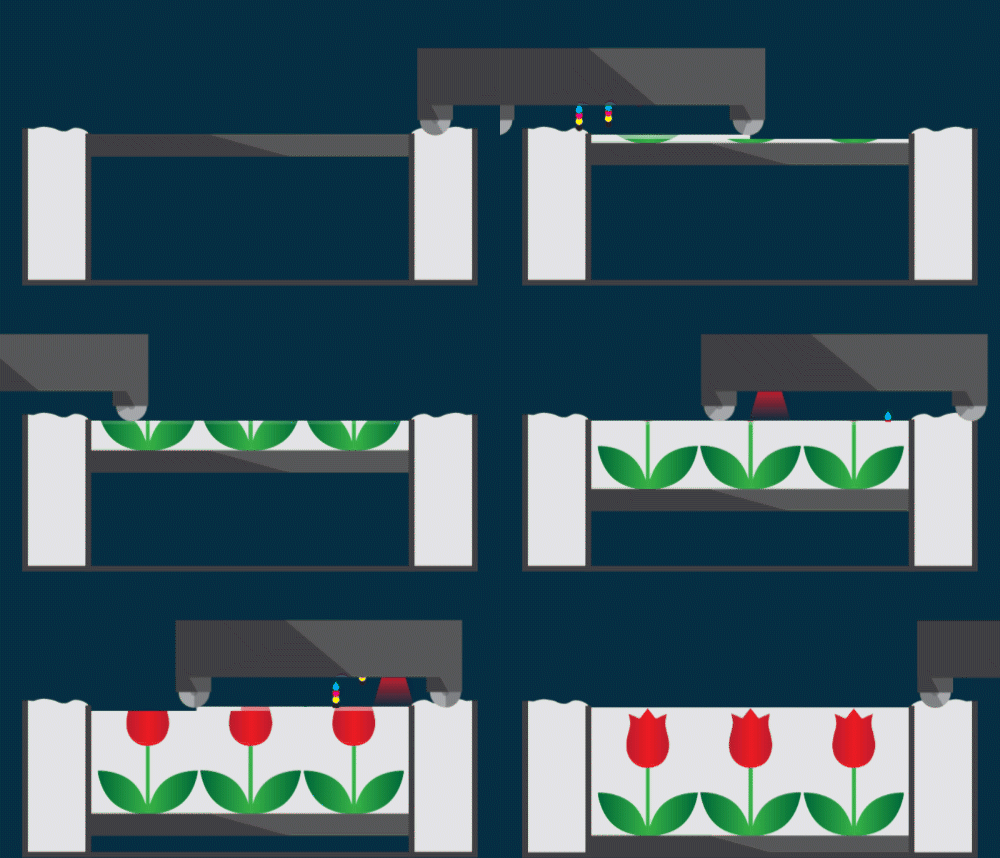
Infrared-absorbent ink is "printed" onto powdered plastic. An IR lamp heats the ink, fusing the powder together.
High Speed Sintering is an exciting new technology that is blurring the line between 3D printing and full production manufacturing. A similar process to LS, it shares many of the same benefits, but offers additional advantages that look set to, pending more development, revolutionize the manufacturing industry.
HSS, like LS, involves melting powdered material to create the layers of models. However, instead of using a laser to trace out the layer, HSS inkjet prints infrared-absorbent ink onto the powder. An IR lamp then heats up the ink, melting the powder particles and fusing them to each other and the layer below. The process is repeated until the part is complete, then the model is removed from the powder and finished with polishing and/or colorizing.
Because multiple parts can be created simultaneously without adding to production time, HSS is on its way to overcoming the biggest hurdle between 3D printing and mass-manufacturing: speed. HSS runs between 10-100x faster than other Additive Manufacturing methods, with the potential to produce up to 100,000 parts per day. Additionally, part costs using HSS tend to be roughly half of those made by LS.
Though one of the newest methods of additive manufacturing, HSS's huge potential is driving companies like Nazdar and Xaar to further develop HSS printhead and IR ink technology. New research is resulting in entire pieces with parts of differing densities made of one continuous material, increasing component strength, flexibility, performance, and recyclability.
"3D Printing/Additive Manufacturing is moving fast in to the realm of volume production," comments Neil Hopkinson, Director of 3D Printing at Xaar and original inventor of High Speed Sintering. "Xaar is gearing up to play a significant role in this revolution for manufacturing, capitalizing on our core technology that is ideally suited to enabling high volume production and also, in the case of High Speed Sintering, by expanding our capability to design industrial grade 3D Printers. The industry transformation we are working on requires strong partnerships across the supply chain and our relationship with Nazdar is a perfect example of this."
Increased market awareness will soon help drive this groundbreaking new technology forward, crossing the print industry into manufacturing, and forever revolutionizing mass-production.
| Pros |
- Little to no waste is produced as excess un-sintered powder (known as "part cake") can be reused up to 100% in subsequent builds with no adverse effect on part surface
- Surrounding powder acts as a support, so little to no support structures are needed
- Cheaper than LS
- No expensive lasers
- Lower machine costs
- Substantially reduces material waste
- Different kinds of polymers can result in different properties
- Flexible, durable, lightweight
- Results can be stronger and more durable than with SL
- Ink systems are not proprietary to machine manufacturer
- Results in cheaper materials
- High Volume manufacturing potential
- 10-100x faster than other AM methods
- Cycle times are independent of part dimensions - Whole layer is 1 pass
- Potential to produce up to 100,000 parts per day
- Inks being developed to create full-color models
- Other cure methods being developed, like energy-efficient UV-LED
|
| Cons |
- Technology still relatively new
- Low market awareness/competition
- Changes in grayscale (for shading) can affect density/part strength
|
Wrap-Up
Additive Manufacturing is taking many new forms, becoming accessible to the average home user even as it becomes efficient enough for full-scale production. With continual developments, print will continue to cross over into manufacturing, pushing the boundaries of new technologies to create evermore innovative, dynamic, high-quality products never before possible.